
Education’s changing at a breakneck pace, and AI’s a big part of that shift Back in the day, learning was all about sitting in classrooms, flipping through books, and sticking to set timetables Today, students can learn anytime and anywhere, thanks to technology. Artificial intelligence, or AI, is playing a big role in making education more flexible, personalized, and accessible for everyone.
This article explains how AI is being used in education, its benefits, possible risks, and what the future may look like—all in simple and human language.
How Artificial Intelligence Is Used in Education
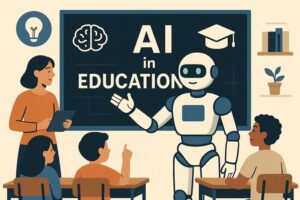
Using smart computer systems to help with learning and teaching in education These systems can grasp student actions, how fast they learn, and their achievements Based on this data, AI tools adjust lessons to suit individual needs.
Online learning platforms use AI to recommend courses, quizzes, and videos. If a student’s having a tough time with a subject, teh system throws in some extra practice to help them out If a student learns fast, AI suggests more advanced material. Learning’s more tailored to each person rather than a one-size-fits-all approach
Virtual tutors and chatbots are another example. Students can shoot questions anytime and get answers right away, even after school’s out
Benefits of AI in Education
AI’s big plus in schooling is tailoring the learning experience to each student Every student has their own unique way of learning Some grasp it fast, others take a bit longer AI helps adjust lessons according to each student’s pace, making learning less stressful and more effective.
Another perk is round-the-clock access to learning AI tools don’t get tired. Students can hit the books at night, on weekends, or whenever they feel like it This is super handy for people studying online and those juggling work and school
AI’s a big help for teachers by cutting down on their workload Automating stuff like marking assignments, grading tests, and keeping tabs on who’s showing up Tihs frees up teachers to concentrate more on teaching and assisting students
Language learning has also improved because of AI. Students can hone their speaking, writing, and pronunciation skills with AI-powered apps that offer immediate feedback
AI Tools Helping Students Today
Many students already use AI tools without realizing it. Grammar checkers are great for polishing your writing Learning apps break down tough subjects into easy-to-grasp concepts Study planners are great for keeping track of time and when exams are coming up
AI also helps students with special needs. Speech-to-text tools ar a big help for students who struggle with writing Text-to-speech gadgets help students who struggle wih reading These tech tools are making learning more accessible for everyone
In college, AI’s a big help for picking classes, figuring out future jobs, and getting ready for interviews
Role of AI for Teachers and Schools
Artificial intelligence is not replacing teachers; instead, it is supporting them. AI helps teachers understand student progress through detailed reports and insights. Teachers can spot where students are struggling early on and give them the extra help they need
Schools use AI to manage administrative tasks such as scheduling, admissions, and communication. This boosts productivity and cuts down on paperwork
AI also helps in online exams by monitoring activity and reducing cheating through smart detection systems.
Risks and Challenges of AI in Education
AI’s got a lot of perks, but it’s not all smooth sailing A big worry is keeping our personal info safe AI systems collect student data, and if not handled properly, this information can be misused.
Another concern is over- reliance on tech Students may rely too much on AI tools instead of developing critical thinking and problem-solving skills on their own.
The problem of digital inequality exists too Not every student has a device or internet access This can create a gap between those who can use AI tools and those who cannot.
Bias in AI systems is another challenge. If AI is trained on limited or unfair data, it may produce biased results, affecting student evaluations.
The Future of AI in Education
The future of education with AI looks promising. Classrooms ar gonna get way more interactive and tailored to each student Students may learn through virtual reality, AI tutors, and smart simulations.
AI could help identify learning difficulties at an early stage and provide support before students fall behind. Career guidance systems could assist students in picking paths that match their skills and interests
However, human teachers will always remain important. AI can assist, but it cannot replace human guidance, emotions, and understanding.
Final Thoughts
AI’s really shaking things up for learning in a bunch of good ways Learning’s got that flexibility, personal touch, adn it’s within reach for everyone Students get more help, and teachers can concentrate more on teaching instead of doing paperwork
At the same time, it is important to use AI responsibly. Keeping student info safe, making sure things are fair, and mixing tech with real-life chats are crucial for winning
AI in education is not about replacing classrooms—it is about improving them. When used wisely, artificial intelligence can help create a better learning future for everyone.